🧠 What You Should Know About the IQ Test
This test is designed to measure your cognitive abilities such as pattern recognition, logical reasoning, and visual perception. Educational background does not directly affect performance on this test; it may have limited influence, but mental practice could have an effect. The questions are generally based on thinking skills, not knowledge. Therefore, the results reflect your mental potential regardless of your educational history.
The Role of Education in IQ Testing
IQ tests do not contain knowledge-based questions. Therefore, the level of education only has an indirect influence. Individuals with very low levels of education may not be familiar with certain test formats, which could make the initial experience challenging. While education can help develop thinking habits and problem-solving abilities to some extent, the aim of the test is to measure abstract thinking ability, not factual knowledge.
Scoring System in the IQ Test
Einstein's IQ was likely around 160, which is commonly considered a genius-level score. A score of 20 represents profound intellectual disability. In our test, users start with an initial score of 130 (gifted level). 130 – 20 (profound disability) = 110 / Number of Questions (e.g., 20) = 5.5 Each wrong answer deducts 5.5 points from the starting 130. A user who answers all questions correctly within the allowed time finishes with 130 points. Additionally, for every correct answer given in under 10 seconds, the user earns +1 bonus point. If all questions are answered correctly under 10 seconds, the user earns +20, reaching a total score of 150 — which is considered "Genius" level.
Perspectives, Perception and Difficulty in IQ Test Questions
Questions in this test are classified into different categories. At the start of the test, a proportional set of questions is selected from each category. It's not accurate to define these categories as levels of difficulty. Each category requires different perspectives. Some questions may be easy for some individuals and difficult for others. A highly educated person may struggle with a question that an uneducated person solves easily. What we refer to as “difficulty level” here is actually a reflection of how differently a question needs to be approached, and it varies depending on the individual's thinking style. Each question may pose challenges depending on one's way of thinking and perception, meaning there is no absolute level of difficulty rather, it reflects how the problem is perceived.
How to Approach the Test
Each question contains a pattern or logic. To reach the correct answer, you need to pay attention to relationships between shapes, rotations, combinations of parts, or arrangements.
🧩 Example 1 – Part-Whole Relationship
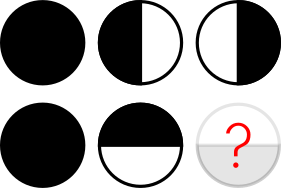
In this example, the far-left cell represents the whole shape, while the two shapes on the right represent parts of it. The missing shape is the one that, along with the other two, can complete the whole. In these types of questions, position, proportion, and direction of the parts are very important.
🔄 Example 2 – Rotation Pattern
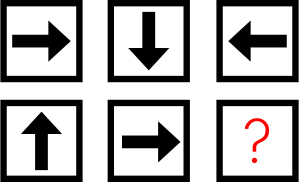
In such questions, attention is paid to the rotation angle of shapes in rows or columns. By analyzing how many degrees each object has rotated compared to the previous one, the missing shape is predicted. A logical and consistent pattern of rotation is sought.
📄 Certificate and Leaderboard
At the end of the test, you can generate a certificate with your name and compare your score with participants worldwide. If you wish, your name and score can be displayed on the leaderboard.